In August 2026 a single Falcon 9 first stage, the booster SpaceX calls B1067, flew for the thirty-seventh time and landed again. The record for the space shuttle, the machine that was supposed to make spaceflight routine, is thirty-nine flights by one orbiter, Discovery, over twenty-seven years. B1067 first flew in June 2021.
That comparison is a little unfair to the shuttle and a little unfair to the booster, and working out why is a good way into the most important change in rocketry this century. This is a long read for people who like spaceships but have not followed launch news closely. It covers what actually gets reused, what happens to a booster between flights, what has gone wrong, and why we, a small team making a browser starship game, ended up designing parts of our game around the same idea. We are an independent studio with no connection to SpaceX; everything here is from public sources, listed at the bottom.
What “reuse” means on a Falcon 9
A Falcon 9 has two stages. The first stage is the tall white cylinder with nine Merlin engines at the bottom; it does the heavy lifting for the first two and a half minutes or so, then separates. The second stage, with a single engine, carries the payload the rest of the way to orbit.
Only the first stage, and the two halves of the nose fairing, come back. The second stage is still thrown away on every flight. People sometimes miss this, so it is worth saying plainly: Falcon 9 is a partly reusable rocket. The part it reuses is the most expensive part, which is why the whole thing works, but it is not an aircraft and was never meant to be one.
After separation the booster flips around, lights some of its engines to slow down, steers with four titanium grid fins near the top, lights its engines again to get through the thickest part of the atmosphere, and finally lands on four folding legs. On lighter missions it can fly back to a landing pad near the launch site. On heavier ones it does not have enough propellant left to turn around, so it lands on a drone ship waiting in the ocean, hundreds of kilometres downrange.
Ten years, in five landings
The history is short enough to tell in a handful of moments.
21 December 2015. After a string of attempts that ended in fireballs on barges, a Falcon 9 first stage came back to Landing Zone 1 at Cape Canaveral and stood upright on its legs. It was the first time an orbital rocket booster had landed vertically after launching a payload. That particular booster never flew again; it was kept as a monument.
8 April 2016. The first landing on a drone ship at sea, after a cargo launch to the International Space Station. Sea landings matter because they make reuse possible on the heavy missions, which are the ones that pay.
30 March 2017. The first reflight. A booster that had already flown launched a commercial communications satellite and landed again. Before this day, a recovered booster was a trophy. After it, it was a product.
May 2018. The last major version of the booster, known as Block 5, flew for the first time. It was designed from the start to fly many times with as little work as possible between flights: tougher heat protection near the engines, titanium grid fins that survive re-entry heating without being replaced, legs that fold back up, and engines built to be inspected rather than rebuilt. At introduction the aim was ten flights per booster with minimal refurbishment.
2021 to 2026. The ten-flight target was passed, then doubled, then tripled. B1067, which began its career launching cargo to the space station in June 2021, reached its thirty-seventh flight in August 2026, according to reports at the time. SpaceX has said it is working to qualify boosters for forty flights. A handful of other boosters are in the thirties.
That is the whole arc: from “can we land it” to “can we land it at sea” to “can we fly it again” to “how many times”. Each step took a year or more, and each made the next one possible.
What happens between flights
The shuttle comparison starts to break down here. A space shuttle orbiter went to orbit and came back carrying a crew and heavy cargo, and between flights it spent months in a hangar while thousands of people inspected and replaced parts of it. That was the problem the reusable booster set out to fix. Reuse that needs an army is only a little cheaper than building a new vehicle.
A Falcon 9 booster has a much easier job. It never reaches orbital speed, so it never needs a full heat shield. Its trip lasts about ten minutes. And because the same booster design has flown hundreds of times, the company knows which parts wear and how fast.
After a landing, a booster is secured to the drone ship and carried back to port, or lifted straight off the landing pad. It is laid horizontal and moved into a hangar. From there the work is a mix of inspection and replacement. The engines are checked, since nine engines, each of which has been started several times per flight, are where most of the stress ends up. Soot from the landing burn, which blackens the lower half of a veteran booster, is mostly cosmetic and is often simply left on. The legs, the grid fins and the thermal protection around the engine section are looked at and repaired as needed. Some boosters are test fired before they fly again; as the fleet has matured, that step has become less common.
How long all of this takes varies with demand. The fastest turnarounds between two flights of the same booster have come down to well under a month, and on a busy schedule boosters fly again within weeks as a matter of routine. SpaceX does not publish a detailed cost for refurbishment, so we will not invent one. The public evidence is the launch rate: a company that can launch more than a hundred Falcon 9 missions in a year, as it now does, is not rebuilding its boosters by hand.
What has gone wrong
A long list of successful landings can make reuse look solved. It is not, and the failures are as instructive as the records.
In August 2024 a booster on its twenty-third flight landed on its drone ship, then tipped over and was destroyed. The payload had already been delivered, so the mission succeeded; the booster did not. Landings are not risk-free even after hundreds of them, and a booster is only reusable if it is still standing.
A month earlier, in July 2024, a Falcon 9 second stage developed a liquid oxygen leak and could not finish its burn, leaving a batch of Starlink satellites in an orbit too low to survive. It was the first Falcon 9 mission failure in years. The cause was traced and the rocket was flying again in about two weeks. The second stage is the part that is not reused, which is worth remembering: reuse does not make a rocket reliable, it makes it cheaper to fly often enough to find and fix the rare failure.
There are also unanswered questions that only time will settle. Nobody has flown a booster forty or fifty times before, so nobody knows exactly how metal fatigue, wiring, seals and valves behave that far out. The careful answer is that each new record is a measurement as well as a milestone.
Why the record matters more than the number
It is tempting to treat thirty-seven as a score. It is more useful to think about what high reuse changes.
The first change is cadence. When a booster can fly again in weeks, the limit on how often you can launch stops being how fast you can build rockets and becomes how fast you can turn them around, process payloads and clear the range. That is a very different kind of company to run, closer to an airline’s maintenance base than to a factory.
The second change is attitude to risk. A company that throws away every rocket has to make each one as safe as possible before launch, because each one is expensive and each failure costs a vehicle. A company that flies the same booster dozens of times learns from every flight, and a booster that has flown thirty times is, in a real sense, better tested than a brand new one. This is the same logic that runs through the Starship test campaign, pushed to the extreme.
The third change is what becomes affordable to launch at all. Large satellite constellations, frequent cargo flights and small research payloads that share a ride all depend on launches being common and relatively cheap. Whether that is good for the sky, which is filling up with satellites, is a separate and important argument. That it happened because of reuse is not really in dispute.
Where reuse shows up in our game
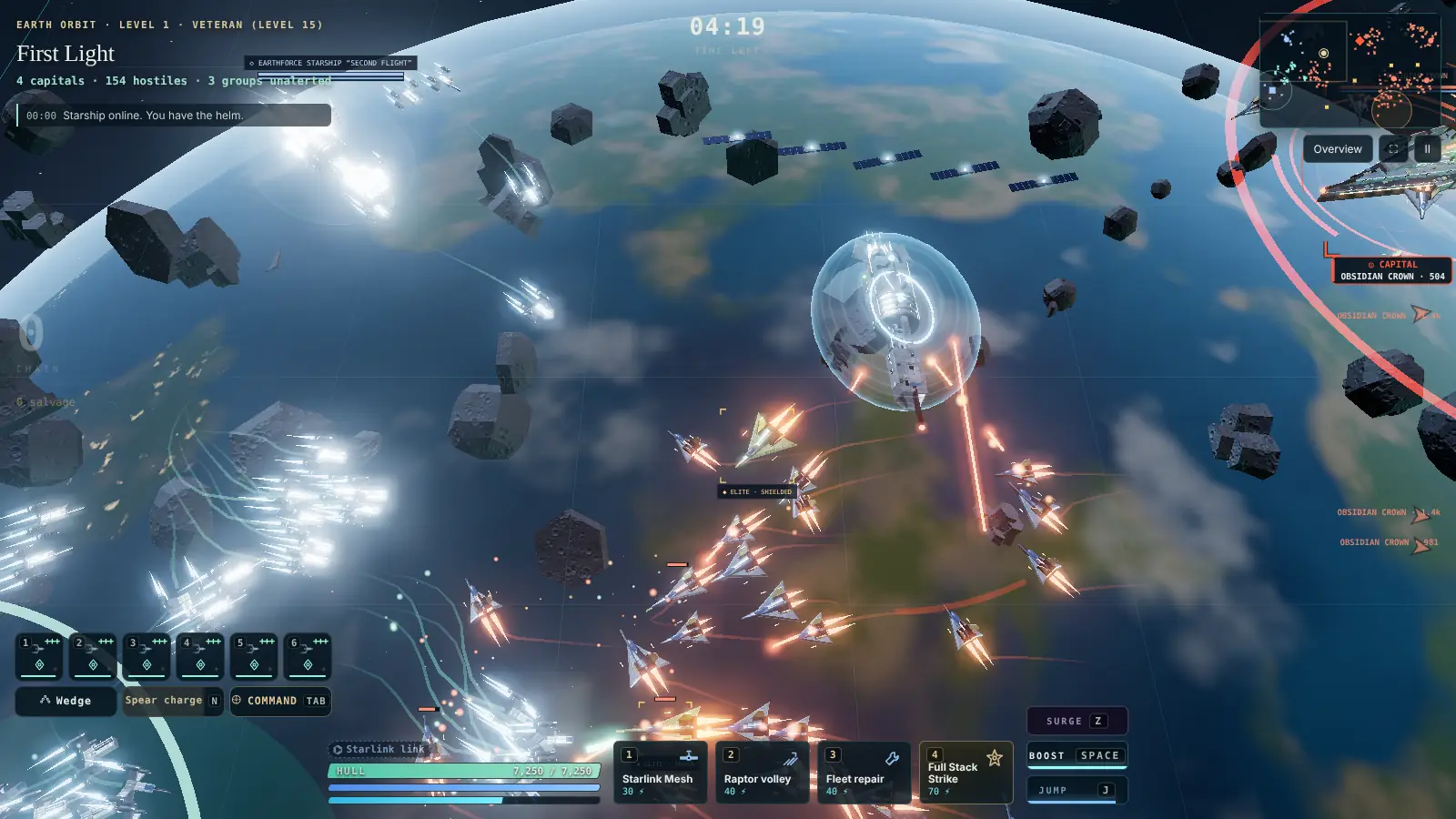
We started Cosmic Starship as a space battle demo and gave Earthforce, the human navy, ships named after real rockets as a fan tribute: the Starship, a Falcon Heavy gunship whose side boosters detach and fight as strike drones, Raptor volleys and a Starlink mesh. It would have been easy to stop at the names. Over time the idea underneath them, that a ship you can bring back is worth more than a ship you build bigger, has crept into the rules.
The Starship’s passive is called Rapid reuse: every ability recharges 15% faster. We chose that over a raw damage bonus on purpose. What reuse buys a real launch company is not a bigger rocket, it is more flights in the same year, and what it buys our flagship is more abilities in the same minute.
In 3.27 we added a relief ship: a second capital you own waits outside the battle and you can swap to it mid-fight. The ship you leave jumps out and repairs slowly on the bench, and you can bring it back later. If that sounds like two boosters on rotation, one flying while the other is in the hangar, that is not a coincidence. A fleet that can rest its ships outlasts a fleet that cannot, even when the rested ships are smaller.
And in the upgrade system, the work you put into your best ships lifts the rest of your fleet to a standard a little below them, so a ship you have not flown for a while is not left behind. It is our version of a lesson every reuse programme learns: the value is in the fleet, not in the single hero vehicle.
We do not want to overstate this. A game is not a rocket, and nobody’s life depends on our balance spreadsheet. But game design and launch operations share one problem: you have a limited number of things, they wear out, and the player or the customer wants more of them, more often. Designing for turnaround instead of for the single best performance turns out to be good advice in both places.
What to watch next
Three things are worth following if this subject has caught you.
The first is the forty-flight mark, and what happens to the first booster that passes it. A retirement, an inspection report or a record would all be informative.
The second is upper-stage reuse. Falcon 9 cannot reuse its second stage and was never designed to. Starship is designed to reuse both stages, and November 2026 saw the first catch of a Starship upper stage after an orbital flight. The day a caught Starship upper stage flies again is the day the next chapter starts.
The third is competition. Several other companies, in the United States, Europe and China, are building boosters that land. Reuse stopped being one company’s trick some time ago, and the next records may well come from somewhere else.
Sources and further reading
- SpaceX: Falcon 9 vehicle page
- Wikipedia: list of Falcon 9 first-stage boosters
- UPI: Falcon 9 booster sets reuse record (August 2026)
- Space.com: B1067’s thirty-fifth flight
- NASA: the Space Shuttle programme
Cosmic Starship is an independent game and is not affiliated with, endorsed by or sponsored by Space Exploration Technologies Corp. Falcon 9, Falcon Heavy, Merlin, Starship, Raptor and Starlink are names and trademarks of SpaceX, used here only to describe its vehicles. Figures are as publicly reported up to November 2026.