Most bugs are typos with consequences. A few are small lessons in design, because the code did exactly what it was told and the result was still wrong. These four are from the versions that added rivals, monsters and squad jobs, and all four were found by tests, not by players.
The monster that spat 86 times
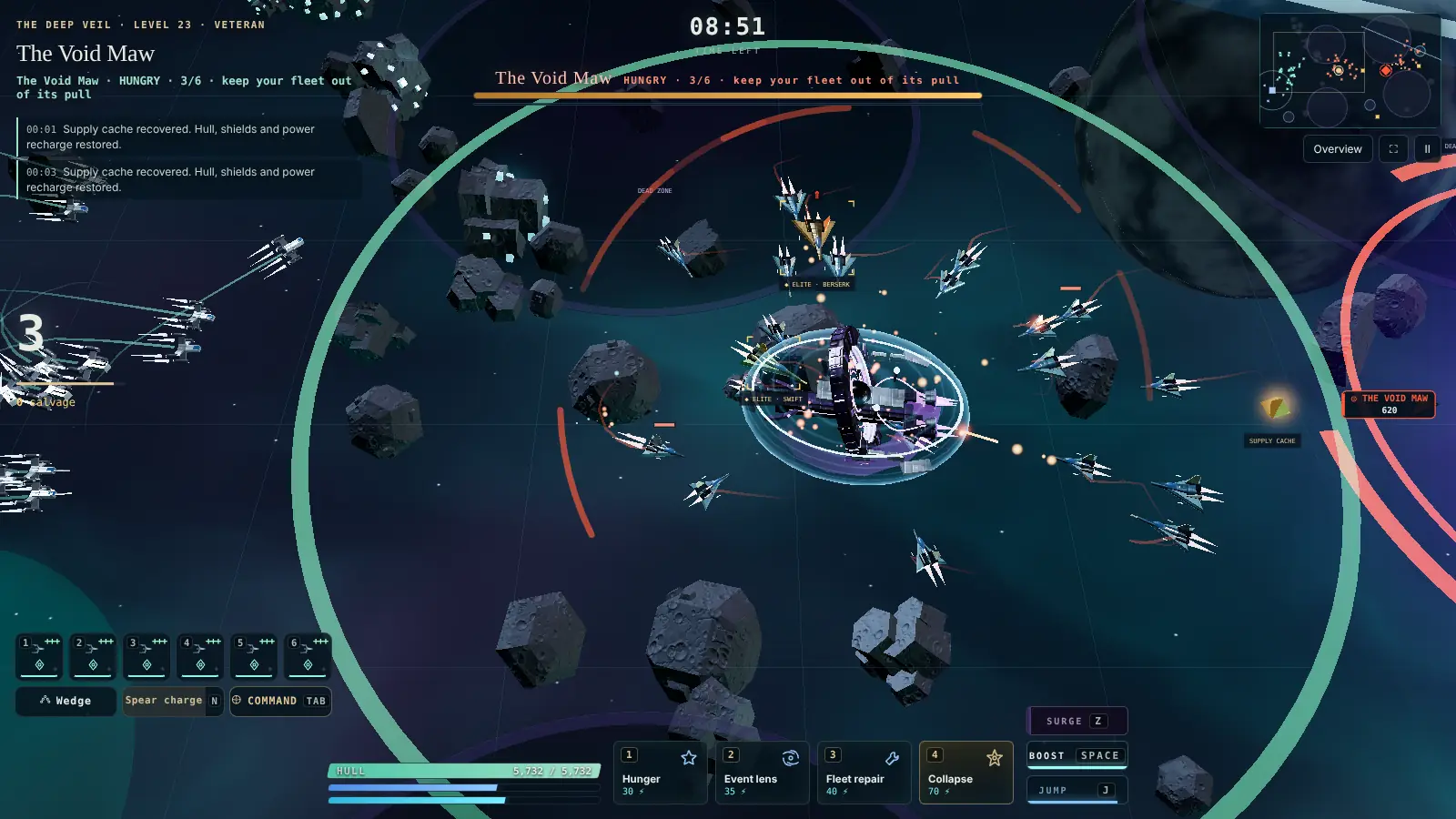
The Wreck-Eater has a simple loop. It swallows the salvage that wrecks leave, heals a little for each piece, and after six pieces it spits out four emptied ships. Kill those ships and they leave salvage.
You can see it coming, and we did not. In the first test of Dark Harvest, a mission where you must make kills quickly, the Eater spat 86 times in one battle. Each spit made four ships, the fleet shot them, they became salvage, the Eater ate the salvage and healed, and the supply of both ships and hull never ran out. It was a perpetual motion machine, fuelled by the player doing their job.
The fix was three limits, each chosen to break the loop at a different point. The Eater can swallow at most one piece every 0.6 seconds. It must wait 14 seconds between spits. And it can spit five times in a battle, no more. We also gave the player something to do with the spit: for six seconds afterwards the Eater’s armour is down. A loop that could not be beaten became a rhythm that can be read, which is what a monster ought to be.
The rival who won the wrong fight
Rivals jump into a battle sixteen seconds after it starts, in a ship with 2.4 times the usual hull. Rask the Bonepicker’s first appearance was planned for an escort mission, which suited him: a salvage broker turning up to pick over a convoy.
He did not bother with the player at all. He flew to the convoy and wrecked it, and the mission was lost through no fault of the pilot. An escort mission already asks you to protect something fragile. Adding a heavy ship with no interest in you turned a hard mission into a coin toss.
We could have taught rivals to prefer the player. We moved Rask instead, to Clan Heads, a mission where the only thing he can threaten is you. Where an enemy is placed is a design decision in its own right, and it was cheaper and safer than a new behaviour that would have needed testing in nineteen other battles.
The reinforcements that tipped the scale
Church of the Quiet strike groups arrive 42 seconds into certain missions. Meridian’s Last Stand, the next-to-last battle of the campaign, seemed the obvious place for one: the Prophet is leading the attack, so his church should be there.
The test pilot had been winning that mission. With the strike group added, it lost. The mission was already tuned to the edge, as a finale should be, and one more capital ship with six escorts was the difference between tense and unfair.
The strike group was taken out of that mission and the story lost nothing, because the Prophet is there in person. What we took from it: a mission that is balanced on a knife’s edge has no room for a new system, however well the system fits the plot. Add it somewhere with slack.
Bombers that would not hold
Squad jobs arrived in 3.13: line wing, bombers, salvagers. A job tells a squad what to do when you have told it nothing. The first version forgot the second half of that sentence. Bombers given a Hold order kept flying off to bomb things, and salvagers ordered to attack kept collecting.
A check of ten situations where a job and an older squad rule could disagree found that problem and others, among them that bomber wings were too weak against the turret pods of bosses, the very targets they exist for. Version 3.13.1 fixed them. An explicit order now always beats a job, and pods and pylons count as warships, so bombers hit them at full strength.
The rule we wrote down afterwards is short: when a new system meets an old one, write out every pair of rules that could contradict each other and test each pair. Ten checks is not much work. Finding the same bugs through player reports takes far longer, and costs goodwill.