The complaint that started this was one blunt sentence: “I just keep pressing Play next and I do not understand anything about the story.” It was not a complaint about the writing. The writing had never been seen. This is an account of what was wrong and what we changed across versions 3.15 to 3.19.
The story was there. Nobody was shown it.
Cosmic Starship had a plot from early on: six regions, a chapter cutscene for each, a briefing line for every mission. On paper that is a campaign. In practice the result screen had a large button that launched the next battle, and a player using it went from explosion to explosion with nothing in between. The cutscenes played once per region, eight or nine missions apart. The briefing lines were on a screen the button skipped.
The easy mistake would have been to write more story. The problem was not quantity. A player could finish all 49 missions without the game once saying why the battle in front of them was being fought.
One card, four things
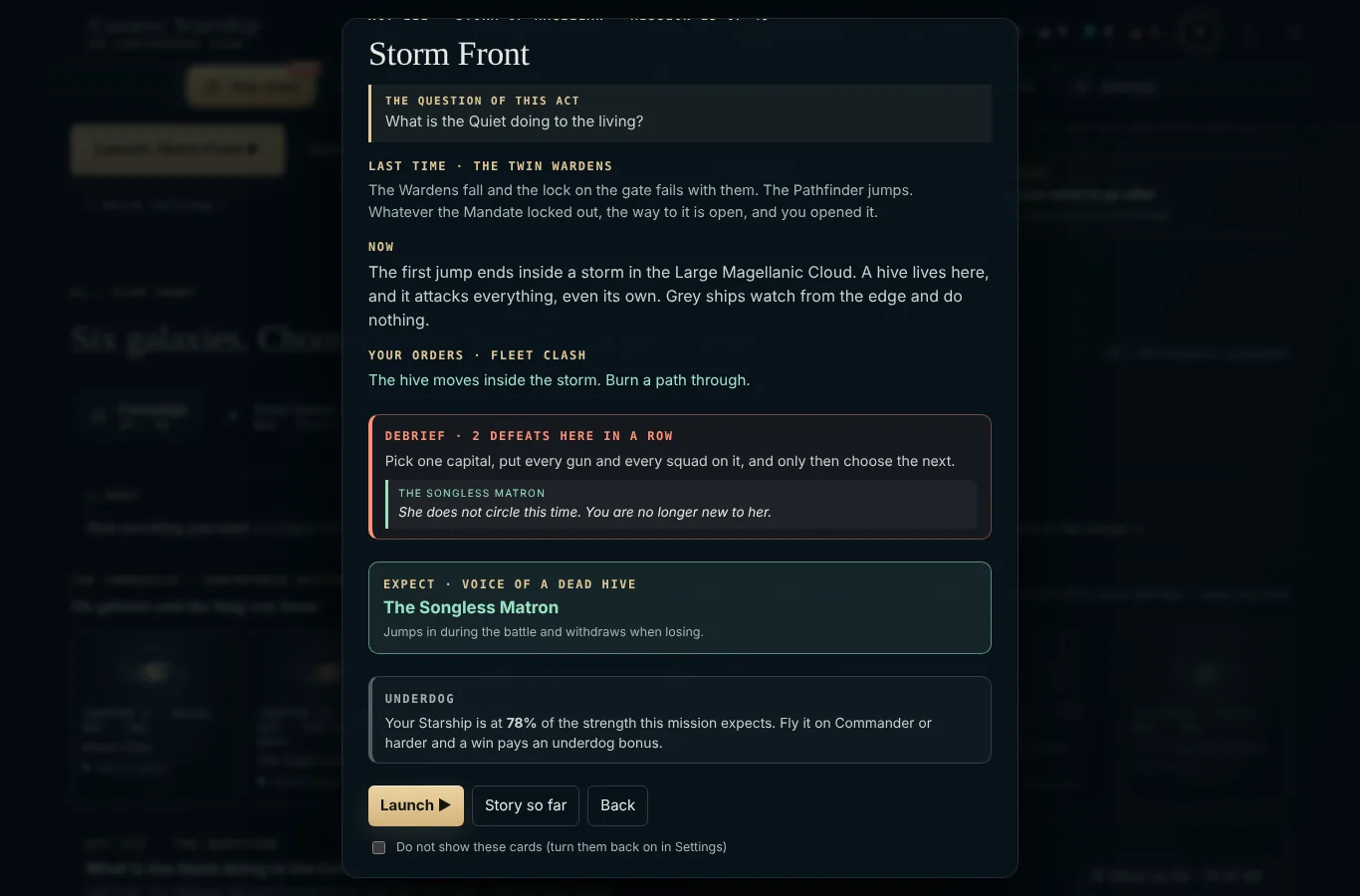
The fix was a single card, shown before any mission you have not cleared, that answers four questions in this order: what just happened, why this battle, what are my orders, and who is waiting for me there. It had to fit on one screen without scrolling, and it had to be possible to turn it off, because the people who replay missions for medals have read it already.
“Last time” turned out to be the important part. It is one or two sentences about the consequence of the previous mission, and it is what turns a list of battles into a sequence. Writing fifty of them was most of the work, because each one has to be true of the mission before it and useful for the mission after.
One question per act
The second change was structural. Each of the six acts now asks one question and answers it by its last mission. Why did the gate open? What is the Mandate running from? Can the seal be saved? The question is printed on the first card of the act and the answer in the log when the act is done.
That gives someone who has been away for a week something to hold on to. There is no need to remember eleven missions, only one question. The story page on this site is organised the same way.
Faces
A war against “the Iron Mandate” is abstract. A war against Marshal Kerrin, who wants your reactor cores and tells you so, is not. Version 3.15 added five rivals who jump into certain missions, retreat when they are losing, and come back. Version 3.16 added two creatures and a church, and had a narrator read every card aloud: a hundred lines, the “why” and the “what this changed” for all fifty missions.
The bet is that rivals do more for comprehension than any amount of text. People remember someone who shot at them.
Two ideas borrowed openly
Two later additions came from things we admire, and it would be dishonest not to say so.
From Hades: a defeat should give you something new to read. In that game every death moves the story forward, which is much of why its difficulty feels fair. Since 3.19, losing a campaign mission here shows a debrief that names the one thing deciding that fight, and a rival who beat you says so. The mission is not made any easier. You are only told more.
From Legend of the Galactic Heroes: the other side has reasons. That series is remembered because you end up respecting both fleets. So each battle a rival fights in now adds an entry to the Captain’s Log written from their side. Kerrin’s entries are a ledger. The Matron cannot speak, so hers are transcripts made by the people listening to her. The Prophet’s start certain and end with a question.
What we would do differently
Put the card in from the first version. Retrofitting connective tissue onto fifty finished missions is slower than writing them connected. And test the story the way the balance is tested: sit someone down, let them play ten missions the way they naturally would, and then ask them what is going on. If they cannot say, the writing is not the problem. The button is.