On 13 November 2026, at 4:47 p.m. Central time, SpaceX launched Starship for the fifteenth time. About a day later the upper stage came back from orbit and settled between the two arms of its launch tower in South Texas. Nobody had caught the ship before. The booster that lifted it never made it home. Both halves of that sentence matter, and this piece is about why.
We make a browser game whose first flagship is called the Starship and whose ultimate ability hurls a booster at the enemy and then flies it home for reuse. So we watch these test flights more closely than is healthy for a small studio with a release schedule. What follows is our attempt to explain Flight 15 to someone who likes spaceships but has not been following every launch, with the history that led up to it and an honest list of what is still unsolved. Cosmic Starship is an independent game. We have no connection to SpaceX, and nothing here comes from inside the company; it is drawn from public reporting, which we link at the end.
What happened on Flight 15
The short version, as reported by several outlets: the vehicle lifted off from Starbase at 4:47 p.m. Central time on 13 November (22:47 UTC). The upper stage, Ship 42, reached orbit, released 26 of the larger third-generation Starlink satellites once in orbit, relit a Raptor engine for its deorbit burn and spent roughly a day in space. When it came down it flew back to the launch site and the tower’s arms closed on it. The catch came at about 3:20 p.m. Central time on 14 November, roughly 22 hours after liftoff, and because the launch time falls on a different date in universal time, you will see both dates quoted.
The booster, Booster 22, was supposed to be caught too. It would have been the first catch of a third-generation Super Heavy. Instead it called off its return to the tower, diverted to the sea and was destroyed offshore. Reports differ on the cause; at least one points to a guidance and navigation problem detected during the return, and others say the evidence does not settle it. We will not guess. What is clear is that the “double catch”, both stages back on the same tower from the same flight, did not happen this time.
That still leaves a first. Super Heavy boosters have been caught since October 2024. Catching the ship, the stage that goes to orbit and has to survive re-entry, is a different and much harder problem.
Why a tower and not legs
Every rocket stage that lands needs something to stand on, and the obvious answer is legs. Falcon 9 has carried legs since its first landing in December 2015. They work, they are proven, and every one of them is weight that has to be lifted all the way up and carried all the way down.
Starship’s answer is to leave the legs on the ground. The tower has two arms, nicknamed the chopsticks, that swing in as the vehicle descends and take its weight on small hardpoints near the top. The idea pays off three ways. The vehicle is lighter, so it can carry more. The stage ends up exactly where it needs to be to be stacked again, instead of on a barge hundreds of kilometres away. And the same arms that catch it can lift it straight back onto the launch mount, which is the step that turns a rocket into something closer to an aircraft.
The cost is precision. A landing leg forgives a few metres of error. A tower does not. The vehicle has to arrive at a point in the sky the size of a parking space, at walking pace, while its engines are throttled near their limits, and the computer has to decide in the last minute whether the approach is good enough or whether to abort and ditch in the sea. The abort is not a failure of the design. It is the design: the rule is that a vehicle with any doubt about its state goes away from the tower, because the tower is far more expensive to rebuild than a booster. Flight 6, in November 2024, aborted a booster catch for exactly that reason when a tower sensor was damaged at launch. On Flight 15 the booster made the same choice.
Why the ship is the hard part
A Super Heavy booster climbs to a few dozen kilometres, separates and turns around. It never goes fast enough to need a heat shield, and it comes home on a fairly short, predictable arc.
The ship goes to orbit, which means close to eight kilometres a second. All of that speed has to be thrown away on the way down, almost all of it as heat. Starship does this belly first, with thousands of hexagonal ceramic tiles on its windward side, and then flips to vertical in the last moments to burn its engines and slow for the catch. Every one of those steps went wrong at least once on the way to Flight 15. Tiles came off. Flaps burned through. Ships broke up during re-entry, or before it, or reached the ocean in one piece only to fall over and explode as designed when they tipped.
So a ship catch is not one achievement, it is a stack of them. The heat shield has to bring the vehicle through re-entry with its control surfaces still working. The navigation has to put it over a tower in Texas after an orbit around a turning planet. The engines have to relight after a long cold soak in space. And the flip and landing burn have to work on the first try, because there is no second one. Flight 15 is the first time all of those held together on the same day.
How we got here
It helps to remember how recent all of this is. Here is the road, as briefly as we can make it.
April 2023, Flight 1. The first full Starship lifted off, lost several engines, failed to separate its stages and was destroyed a few minutes in. The launch also tore up the concrete under the pad, which led to a water-cooled steel plate that has been used ever since.
November 2023, Flight 2. The stages separated using hot staging, where the ship lights its engines while still attached to the booster. Both were lost later in flight, but the separation, which had never been done at this size, worked.
March 2024, Flight 3. The ship reached space and coasted on its planned path, then broke up on re-entry. It was the first time a Starship had gone that far.
June 2024, Flight 4. Both stages came down softly in the water as planned. The ship lost part of a flap to re-entry heating and still flew to a controlled splashdown, which is the moment many people started to take the programme seriously.
October 2024, Flight 5. The tower caught a Super Heavy booster for the first time. It is still one of the strangest pieces of footage in spaceflight: a twenty-storey rocket hanging from two arms, engines off, steam rising.
2025, Flights 7 to 11. This was the hard year. The first three flights of the second-generation ship were lost, two of them over the Caribbean and one after losing control later in flight, while the boosters kept proving that catches were repeatable. Flights 10 and 11, in August and October, were clean: the ships released dummy satellites, relit an engine in space and splashed down on target in the Indian Ocean.
2026, Flights 12 to 15. The larger third-generation vehicles arrived, with more powerful Raptor engines and a new pad. The first of them were still suborbital. Flight 14, on 28 September, was the first Starship to reach orbit and the first to carry a real payload, 26 Starlink satellites, even though one of the ship’s six engines failed on the way up and the time in orbit was cut short. Flight 15 repeated the orbit and the payload and added the catch.
Read as a list, it looks like steady progress. Lived through one launch at a time, it looked like a programme that blew up a lot of hardware. Both readings are true, and the second one is the method.
The method is the point
Most space programmes test on the ground until they are confident and then fly once, carefully. SpaceX has done the opposite with Starship: build quickly, fly early, accept that the vehicle may be lost, and treat each loss as data that would have taken months to get on a test stand. It is an approach that only works when the vehicles are cheap enough to lose and the factory can make the next one fast, and it draws real criticism, from debris falling near islands in the Caribbean to the effect on wildlife around the launch site. Those concerns are fair and deserve their own article; regulators have investigated several flights.
What interests us as game developers is narrower. Iteration works because each test is designed to answer a specific question, and because someone writes the answer down. A ship that breaks up on re-entry is a disaster if you hoped it would land. It is a result if the point of the flight was to learn where the heat shield fails. The flights that looked worst on the news often taught the most.
We work the same way on a much smaller scale. Before we keep a new rule in Cosmic Starship, a test program flies thousands of battles with it and measures what happens; our dev notes are mostly the record of tests that said no. Nobody loses a rocket when one of our tests fails, but the habit is the same. Decide what you are trying to learn, run the test, believe the result even when you do not like it.
What is still not solved
It would be easy to treat Flight 15 as the finish line. It is not, and pretending otherwise does nobody any favours.
Catching both stages on one flight. The booster catch has worked many times with the older vehicle. It has not yet worked with the third-generation booster, and Flight 15 showed that the new hardware still has surprises in it.
Flying a caught ship again. A booster that has been caught can be inspected, refurbished and reflown; SpaceX has done it. A ship that has been to orbit has a heat shield that took real punishment. Until a caught ship flies a second time, full reuse of the upper stage is a promise, not a fact. That is the step that changes the economics, and it has not happened yet.
Moving propellant in orbit. NASA has chosen a version of Starship as the lander for its Artemis programme, which aims to put astronauts back on the Moon. To get there, a Starship has to be refilled in Earth orbit by a series of tanker flights. Transferring large amounts of super-cold propellant between two vehicles in space has never been done at that scale. It is the single biggest open question in the Moon plan, and dates for it have moved before.
Doing it often. The promise of Starship is not one spectacular flight; it is flights every few days. That depends on how fast pads, towers and vehicles can be turned around, and on regulators being satisfied that each flight is safe. Neither is a solved problem in 2026.
None of this makes Flight 15 small. It means the hard part has moved from “can this be done at all” to “can this be done routinely”, which is the kind of problem engineers prefer.
What we borrowed for the game, and what we did not
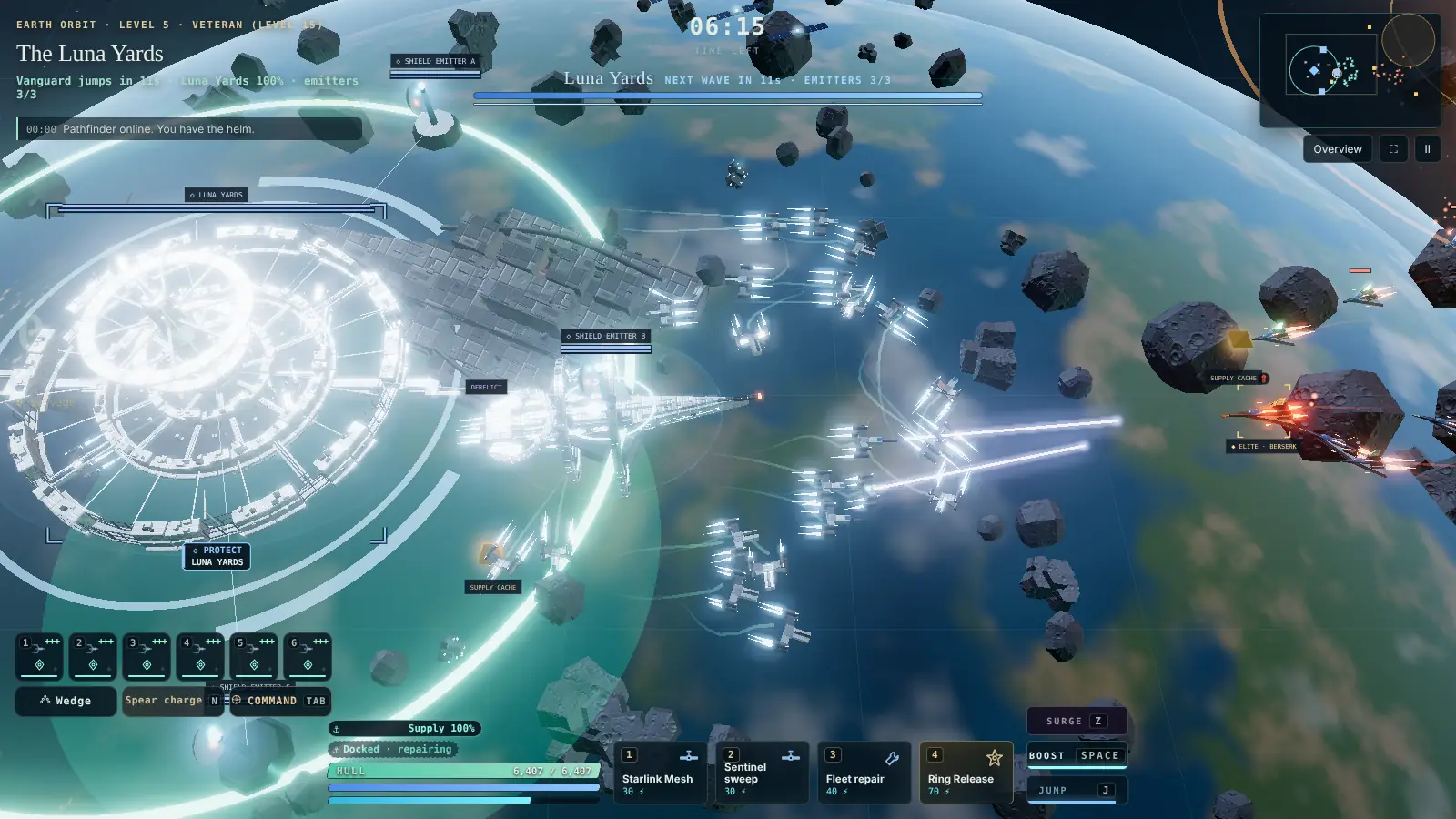
The Starship in Cosmic Starship is a fan tribute, not a model of the real one. It is a gunmetal launch carrier, armed and shielded, because it is a warship in a space opera. Three things in it come straight from watching these flights.
Its ultimate, Full Stack Strike, launches a booster down your aim line and then brings it home for reuse. It is a joke for anyone who has watched a catch, and it is also the most satisfying thing in the game to aim. Its passive, Rapid reuse, makes every ability recharge 15% faster, which is our idea of what reuse is for: not saving money, doing more in the same amount of time. And its signature skill is a Raptor volley of six strikes, because we wanted the engine name somewhere in the ship that carries the name.
What we did not borrow is the risk. A real launch is a bet with hardware and, around the launch site, with real people and real places. In a game you can fail a mission and fly it again in two minutes, which is exactly why games are a nice place to think about engineering and a terrible place to learn its costs. When we write a test flight into the game, it is always the fun part of the story. The real ones are the hard part, and the people who do them deserve the credit for that.
Where to follow the next flights
The most reliable place for launch dates is SpaceX’s own updates page, which also posts a summary after each flight. For context and history, the Wikipedia list of Starship launches is kept up to date by people who care a great deal about getting the details right, and NASA posts its own updates on the Artemis lander. We will keep watching, and if a caught ship ever flies a second time, expect a new spaceflight note from us within the week.
Sources and further reading
- SpaceX: updates and flight summaries
- Wikipedia: list of Starship launches
- Space.com: Flight 15 launch report
- CNBC: SpaceX launches Starship in key test flight
- PBS NewsHour: Starship soars into orbit after booster malfunction
- NASA: the Artemis programme
Cosmic Starship is an independent game and is not affiliated with, endorsed by or sponsored by Space Exploration Technologies Corp. Starship, Super Heavy, Raptor, Falcon and Starlink are names and trademarks of SpaceX, used here only to describe its vehicles. Dates and outcomes are as publicly reported in November 2026.